 |
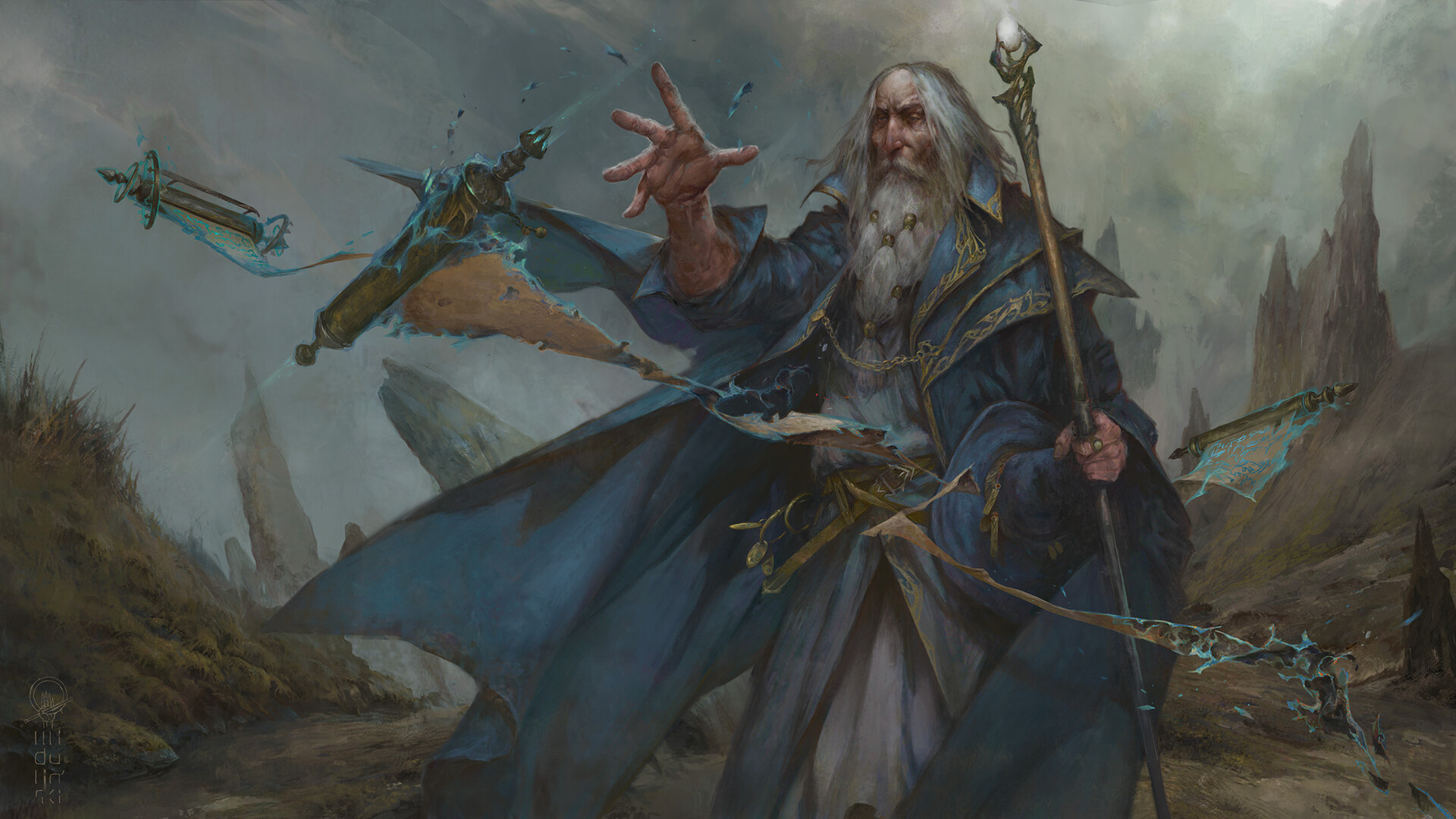
| Merlin by Iwo Widuliński |
This is a sort of secondary post to my previous Whitehack Magic 101 post a while back. Check it.
As noted previously, the Wise and the rules for Miracles remain common subjects for discussion. Rather than focusing on how the rules themselves work, this post will assume you've got the basics from 101 down and focus more on what you can do to make miracles work for your campaign.
That said, I'll post the core flow here for ease of reference.
All miracles always work like this:
- PC says what they want to do.
- Referee triangulates and negotiates a cost.
- Is the cost/could the cost be above HP = no go, stop here.
- Perform the miracle effect.
- Look at cost (roll dice if needed).
- If below/equal to level, pay it and jump to 8.
- Else: save or double it, and pay.
- Follow rules for Damage, HP & Death.
Memorize it. Live by it. This is your Wise Mantra.
How do I make a martial-caster spell-sword type Wise character?
- Less HP than the Fighter.
- Less spells than the Magic-User.
- Slower experience advancement than any class (aka comparably weaker than their peers).
- Can use any arms and armor.
- Can cast magic-user spells.
I think that's doable! Such a character will probably not be the best at fighting nor at spells, but would be flexible which tracks with the above assumptions. A Wise spell-sword is going to need to have very precise and deliberate wordings for low costs if they want to rock medium or heavier armor with the penalty. A light-armor clad Wise spell-sword would have no such limitations, perhaps relying on miracles to make up for it with wordings like "Shield" or "Mana Armor", etc.
Here's a sample character! A Wise Elf Sword-Mage:
Deedlit, Level 1 Wise Sword-Mage
Str 10, Agi 16 (Elf), Tgh 12, Int 15, Wil 13 (Sword-Mage), Cha 13 (Elf); HP 6, DF 3, MV 30, AV 10; Miracles: "Enchanted Sword", "Fire Bolt", "Floating Lights"; Common, Elvish; Elegant Long Sword, Elvish Leather Armor, Dagger, Ingredient Pouch, 11CR.
Deedlit got a good roll for her HP, so her player opts to pick very simple and precise miracle wordings. They won't be flexible but they will be cheap. She's not as good a warrior as the party's Strong Knight, but her magics will give her an edge, especially against foes immune to mundane weapons or damage. Grabbing some scrolls and keeping ingredients on hand to keep magic cheap will be good too. Slotting a magical item, hopefully some sort of weapon, would give her a good boost of HP at 3rd level and the Referee has informed her player that the blacksmiths of Elfland to the east make Mithril Chainmail that protects as normal chainmail armor but is as light as a feather... and wouldn't penalize her magics! Sounds like the next adventure!
I'm running a traditional D&D adventure. How do I match the power-level of spells?
Whether you're running T1 The Village of Hommlet or some new OSE module you probably want your Wise character's to be able to interface with the assumption of 6 (maybe 9 if you're really advanced) levels of spell power. Or maybe you just want to stick with what you know for magic, that's fine too.
The first way of doing this is looking at the magnitudes and how they can map to your assumptions. Whitehack specifies four broad Magnitudes that can be further modified by a referee determined amount of cost*. For example, a powerful magnitude miracle would cost 2d6 HP but a notably boosted powerful miracle could cost 2d6+1, 2d6+2, or even more.
Secondly, the "Traditional Magic Effects" table in Whitehack can help your adjudication as it just shows the level of character usually assumed for that type of effect, e.g. in classic games, you aren't stopping time or reincarnating someone unless you're level 9 or higher.
Putting these together, an enterprising referee should be able to roughly sketch out their scale of power. Here's how I could roughly gauge classic D&D effect analogs for an OSE adventure:
- Your absolute weakest spell effects in the setting should be either zero or simple magnitude. E.g. a 1st-level cure light wounds effect falls squarely in simple base cost.
- Your most potent spell effects in the setting should be powerful magnitude and likely several cost modifiers. E.g. consider the 6th level death spell. Checking out traditional magic chart, instant killing is 10th level magic-user territory (powerful). It's got a notably long range (+ cost) and can instantly kill multiple creatures (+ cost) in an area. 2d6+2 is not an unreasonable cost!
- With the edges of the scales considered, every other spell effect falls somewhere in between. E.g. the 3rd level lightning bolt can looks like "substantial elemental attacks" on our chart (major) and has a good range (+ cost), and can affect multiple targets (+ cost), but can bounce back at us (-cost). d6+1 is a reasonable cost.
- This is even before PC specific considerations that my drastically alter these costs. Your necromancer might get a discount on a death spell like effect, but will probably not be throwing lightning bolts anytime soon!
- If you're working with material that goes to 9th level-spell like effects, you could stretch this scale as needed. Your time stop that affects everyone around you in a wide area with no saves is probably stupid expensive even if you're a Wise Time Wizard. I imagine this would be relevant for a small minority of games, so don't sweat the hypotheticals.
*Note that the lack of limits on the cheaper or costly modifiers is explicitly intentional. Your Wise character looking to Summon Elder Deity should probably not just be paying 2d6 HP! And recall that your character can't even attempt miracles with an initial max cost above their current HP and anything over your level is a save or doubled cost! Consider the peak of magical power someone could have in your campaign and look at the average HP of a 10th level Wise (about ~~25 HP barring shenanigans). If the power should still be risky and dangerous it could cost 2d6+6 or more!
My setting has multiple, distinct magic systems. How do they co-exist here?
No real reason to handle things outside of the usual procedure. Recite your mantra!
However, your rulings on what is possible, weak, or strong now need to separately consider each type. For each type of magic, briefly sketch out what it is good at, what it struggles with, and write down any notable requirements or characteristics e.g. needs lots of time, not meant for combat, only affects believers, its wholly item based, is invisible to non-wizards, etc. These can be your natural language guidelines for interpreting effects, without needing to create additional subsystems.
Consider a setting with arcane magic, divine magic, and psychic magic like Dark Sun. This is a setting where arcane magic drains surrounding life, divine magic focuses on the elements of the world or worshiping evil sorcerer-kings, and nearly everyone has psychic abilities that come from an internal power. Even these simple descriptions would all impact wordings, possible effects, and costs when used on a case-by-case basis. An arcane-styled Wise character could simply not use any miracle wordings without draining the life from their surroundings in this case to power their use of "Arcane Fire", whereas a divine-styled Wise would have no such worry using "Summon Elemental Flame". Even though its an entirely fictional setup, you can use some common sense and logic here.
My setting has little to no magic. Do Miracles still have a place?
Potentially! Whitehack 2e used to mentioned that “Wise characters can do things that are (or others perceive to be) magic.” and “Magic does not have to be actual magic. An apothecary’s or scientist's mad experiments may seem magic to ordinary folk.”. This assumption lets the core assumption of the Wise to function in a way though conceptually it might be challenging. Spend some HP as your alchemist spends all night concocting new poisons. You're tired and not able to mitigate harm as well? Ymmv!
In these circumstances I personally swap out the Wise to no longer be a basic class and don't often sweat it. Miracles might not have a place and that's ok. For example, a Whitehack campaign à la Conan might have such impossible magic be entirely the realm of antagonists and monsters rather than PCs if so desired. My sci-fi campaign that might not have any room for people wielding impossible forces.

No comments:
Post a Comment