Friday, July 2, 2021

A Fistful of Mechs

Armored Core V by yutori-custom

Wanzers (derived from German wanderpanzer; wander for "walking", and panzer for "armor") are weapons from an older age, discovered buried in the ground. They are refurbished and crudely rebuilt to be used as military weapons. While nowhere near as powerful as their past iterations due to their poor reconstruction, they retain strong offensive and defensive capabilities, making them powerful war machines and highly sought after.

Most stand 5-7 meters tall and are designed for urban combat situations. They are primarily focused on ground-based operations and have limited aerial capabilities, being unable to fly for or maintain height for an extended period of time. They do have heightened mobility on the ground, boosting and gliding along the ground at high speeds.

n.b. The rules already have some opinions on how vehicles work. Per the rules on p.88:

  • "... allow each vehicle to have hit points, movement, AC, ST, and weaponry just like a character, and maybe also special attack or repair options."
  • "The characters engaged in the battle are allowed control over one or several of these things each."
  • "For some things, the characters' stats can be used."

See my post on modern violence for how to handle movement, equipment burden, and weapons. Mechanically speaking, these are piloted dragon stat blocks using modern weapons and the normal combat rules with some added bits and a coat of sci-fi paint.

Adjudicating Wanzers

In addition to the general vehicle rules, keep the following in mind:

Mods. These act like the implants on p. 89. Minor mods can grant the listed bonuses, mod keywords act like very limited groups (i.e. can grant double rolls), and major mods replace an attribute altogether.

Mods complicate the piloting process. Only the most experienced pilots can wield such machines to their full potential. Pilots can only utilize one mod but can accommodate one more at levels 3, 6, and 9. 

Weapons. Equipped on each arm, with two more stored on bay units on the shoulders. Swapping a current weapon with one stored in a shoulder hanger counts as a small action. Some mechs may have heavier or experimental weapons equipped on their back as well. These have their own restrictions.

Keeping in mind that I treat these like dragons, HD 5+ mechs can attack twice, HD 10+ three times, and HD 15+ get four. The last attack must be AV 10 and they have to forsake their move. 

Weight. As mentioned above, wanzer's use the rules for equipment burden and act as if they have a backpack (i.e. 14 slots). They count AC, weapon size, and spare ammo towards their total. 

While they can use two-handed weapons with one arm, they still count as two slots!

Damage Types. All weapons and armor come in three damage type categories: Kinetic (KE), Chemical (CE), and Thermal (TE)

Bullet-based projectiles deal KE damage, Chemical/Explosive type projectiles deal CE damage, and energy weapons deal TE damage. 

If the damage type is an armor weakness (W), it's treated as AC -1. If the damage type is an armor strength (S), it's treated as AC +1.

These can cancel out! If you have TE weakness, but get TE strength from some source, you'd treat it as normal. Neither a strength nor a weakness. 

Critical Damage*. When a Wanzer is reduced to 25% HP, they must make a critical damage roll (d6):

  1. Loss of Footing: pilot must save or the wanzer staggers, giving foes Combat Advantage.
  2. Knocked Unconcious: pilot must save or skip 1d3 rounds.
  3. Weapons Down: the wanzer's weapons are down for 1d3 rounds.
  4. Comms Down: audio/video feed down for 1d3 rounds.
  5. Cockpit Fires: 1d3 rounds of 1d6-1 damage to the pilot.
  6. Malfunction Explosions: 1d6 damage to mech and pilot.

    *Stolen from Ternwillow

    Making Wanzers

    I generally handwave the process but these random tables could help streamline things.

    The main parts of a wanzer are as follows:

    • Head: visual sensors, scanners, CPU equipment, etc.
    • Core: pilot controls, grants HP and ST.
    • Arms: weapons are fixed here.
    • Legs: govern movement type.
    • Generator: powers all other components of the wanzer.
    • Boosters: the thrust system that lets a wanzer boost along the ground or jump in the air.
    • Arm Hangars: store weapons and allow swaps mid-engagement. 
    • Shoulder Unit: an optional utility hard-point.

    Being refurbished and scavenged war machines from a bygones era, you don't exactly get to go shopping for the perfect configuration. You make do with what you have. 

    Roll 1d6 to determine the wanzer type:

        1-2: Light. HD 4-10. AC 4-6. Strengths: KE. Weaknesses: CE & TE.

        3-4: Medium. HD 6-12. AC 5-6. Strengths: KE. Weaknesses: CE & TE. 

        5: Sniper. HD 4-10. AC 4-5. Strengths: CE. Weaknesses: KE & TE.

        6: Heavy. 8-14 HD. AC 7-9. Strengths: TE. Weaknesses: CE.

    Randomly determine Hit Dice and use that to get Hit Points

    The Saving Throw is equal to HD+5. Randomly determine AC as well.

    Determine its leg-type (d6):

        1-3: Biped. Standard. Legs are good for walking when you aren't gliding along.

        4: Reverse Joint. Great jumping ability. Grants CE Strength and TE & KE weakness to Heavy types.

        5: Tetrapod. Can take a turn deploy, gaining Combat Advantage on ranged attacks but can't move.

        6: Tank. +4 HP and +1 AC but twice as slow (i.e. two move actions to travel a short distance).

    Weapons follow the linked rules above for simple weapons. They could be handguns, shotguns, gatling guns, machine guns, howitzers, battle rifles, sniper rifles, laser rifles, laser blades, physical blades, cannons, etc.

    Take four weapons, give them fittingly military tech-sounding names, and work out what they are.

    You may take RLDs (spare ammo) for any weapon, counting each RLD as a minor item.

    Give it a cool call-sign (or steal one from your favorite mecha anime or vidya).

    Roll (d6) for what kind of mod you start with and work with your Ref and fellow players to figure out what it is.

    1-3: Minor Mod; 4-5: Keyword Mod; 6: Major Mod.

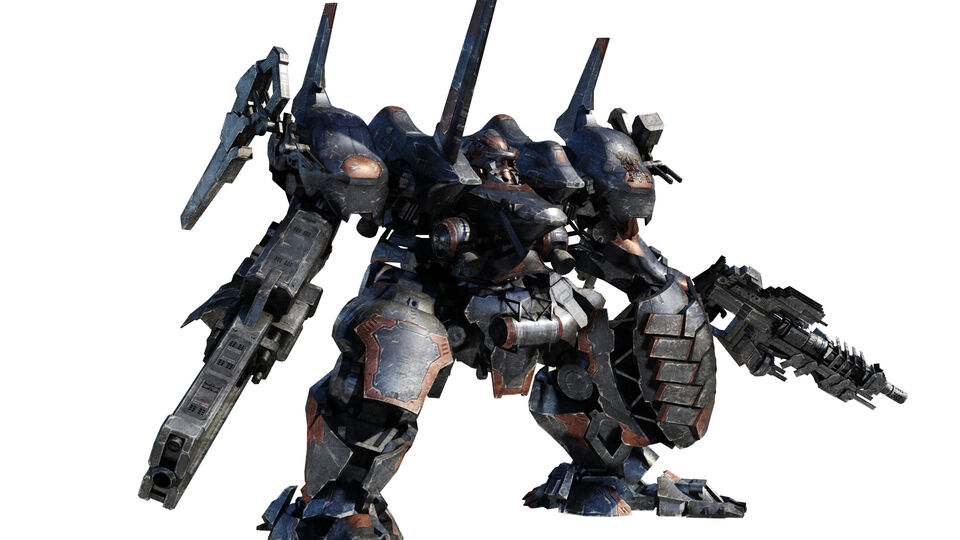
    Sample Wanzer - THE HANGED MAN
    From Armored Core V

    CALLSIGN: HANGED MAN | PILOT LVL: 6

    HP: 35 (HD: 10)AC: 8 (Strength: TE, Weakness: CE) | ST: 15

    WT: 16 used / 16 total

    WPN SYSTEMS: 

    • R ARM: UBR-05/R (medium CE rifle, long-range). 1x RLD.
    • L ARM: Tansy RF12 (medium KE rifle, long-range). 1x RLD.
    • R BAY: ULB-13/H (medium TE laser blade, melee).
    • L BAY: USG-11/H (large KE shotgun, short-range).
    • SHLDR: UMM-20/H Surat (medium CE missile, long-range).
    MODS:
    • KT-2R3/Dafeng. Minor. High-powered booster. +2 inventory spaces.
    • Verseau RG-04zz. Minor. Advanced CPU fire-control system. +1 Initiative.
    • Analytical AR enhancements. Keyword for sensory task rolls and other relevant tasks.
    ---

    If you can't tell, I've been on a bit of an Armored Core and Front Mission kick over the past few months. I suppose this is just how they finally bleed over into my hobby time.

    Tuesday, June 29, 2021

    Modern Day Violence in Whitehack

    Hard Boiled (1992) dir. John Woo

    I've been running a table through a Whitehack spycraft game set in an unclear time in the late 20th century. This is a far cry from the typical faux-medieval milieu, but only a couple of adjustments have been needed to transition from swords and spears to the semi-automatics and machine guns. Remember, keep it fast and nasty.

    n.b Whitehack 3e has an optional rule section for "modern and futuristic weapons" already. I used this as a base and combined it with some additional considerations, but it works well enough on its own!

    Hard Boiled (1992) dir. John Woo

    ABSTRACT DISTANCE & MOVEMENT

    During a frantic firefight, the last thing I want is to count the exact distance when the guns come out.

    MV is removed. There are now five broad distance categories: close, short, medium, long, and distant.

    • Close is everything within a couple steps.
    • Short is how far a person can walk in ~10 seconds.
    • Medium is how far a person can run in that ~10 seconds.
    • Long is how far a person can run in a minute.
    • Distant is the distance a person could run in 10 minutes.

    These are relative to people. Just replace "person" with "car" or "speedboat" if you need to scale up.

    In combat, characters can move up to a short distance with a movement action. Two movement actions let characters move up to a medium distance. Moving within a close distance only needs a small action.

    Stolen from Solar Blades & Cosmic Spells

    Hard Boiled (1992) dir. John Woo

    EQUIPMENT BURDEN

    In the vanilla game, equipment burden affects your Movement (MV). We don't have MV so the MV penalties for carrying a ton of junk need adapting. Now, equipment burden affects your ability to act effectively. Strength can still be used to overcome this, however.

    Each character has 10 slots for equipment, but the tenth slot may be occupied by a 5-slot backpack or another suitable container, for a total of 14 usable slots. Having high Strength affects your ability to handle equipment beyond your number of slots. 

    At the end of each time unit* when you are over-encumbered, you need to pass a Strength task roll or rest for one time unit before doing anything else. If you exceed your maximum load by more than one, you need to pass a Strength task roll to start moving at all, and then again every time unit

    The amount you are allowed to exceed your limit by is increased by +1 at Strength 13 and another +1 at Strength 16.

    Stolen from Suldokar's Wake.

    *Here "time unit" simply refers to whether we're dealing with rounds, turns, days, etc.

    Hard Boiled (1992) dir. John Woo

    WEAPON ADJUSTMENTS

    These John Woo gifs are no coincidence. Be sure to stretch the phrasing of the Strong's cleave ability to include ranged weapons and enemies adjacent to one another!

    Weapons are grouped in large categories for ease of play.

    • Unarmed. 1d3 damage. Punching, kicking, etc.
    • Small. 1d6-1. Brass knuckles, knives, etc.
    • Medium. 1d6. Axes, bats, swords, etc.
    • Large. 1d6+1. Claymores, spears, halberds, etc.
    Ranged weapons are grouped similarly.
    • Small. 1d6-1. Medium range. Revolvers, pistols, etc.
    • Medium. 1d6. Long range. Heavy pistols, semi-auto weapons, crossbows, etc.
    • Large. 1d6+1. Distant range. Rifles, shotguns, machine guns, longbows, etc.
    For ranged weapons, the given range is its standard range. Weapons can be fired one distance category further away at a -4 AV penalty. Longer shots are nigh impossible.

    Small weapons are easy to hide. Large weapons need two hands to wield and are extremely conspicuous. Medium ranged weapons can be used with one hand in a pinch (-2 AV), but often work much better with two.

    n. b. Remember that weapons will have other benefits and drawbacks in different circumstances as well. The Referee should consider these and apply Combat Advantage, penalties, and other adjustments as appropriate (e.g. usable in a grapple, reach, armor-piercing, concealable, loud, etc.). Use common sense and discussion.

    These make most weapons quite easy, but may not properly portray everything!

    E.g. a shotgun could do 1d6+1, but would have a short range. A flamethrower could hit everyone in a cone up to short range for 1d6 if they fail a save. Crossbows can fire every other round. Black powder muskets may fire once every three rounds. Modify to fit whatever you're thinking of.

    Stolen from Solar Blades & Cosmic Spells

    Hard Boiled (1992) dir. John Woo

    OTHER CONSIDERATIONS

    Don't stand out in the open in a firefight. Take cover.

    • Cover stops bullets. Characters hiding behind cover cannot be hit by direct fire.

    • Partial Cover is when characters attack from behind cover. -4 AV to hit a target behind partial cover.

    • Concealment hides you from attackers. -2 AV to hit a target behind concealment.

    Armor grants AC as normal, but we're not dealing with chainmail or plate suits.

    • Light. AC 2. Civilian-grade protective armor such as that provided by leathers or layers of heavy cloth.
    • Medium. AC 4. The more obvious type of body armor, like a security-grade tactical outfit or bulletproof vest.
    • Heavy. AC 6. Heavy-duty military-grade tactical body armor; impossible to hide and extremely protective.

    Armor and cover may not always apply during all types of attacks. Use common sense and discussion.

    Some other quick additions that have come up:

    • Explosives deal full damage to everyone in close range and half as much within short range. Those who can dive for cover can save to avoid damage.
    • Incendiaries catch a target on fire unless a save is made; 1d6 damage per round until put out.
    • Let the Strong's cleave ability include ranged weapons and enemies adjacent to one another.
    • Use the 3e rules for Burst and Full Auto for automatic weapons (pp.84-85).
    • Ammo isn't tracked exactly. Use the 3e rules for abstract ammo (pp.84-85).
    • Add the Suppressive Fire special combat option from 3e (pp.84-85).
    • Add the Spray Ability for the Strong to choose from in 3e (pp.84-85).

    Monday, May 10, 2021

    OD&D/WHITEHACK

    Katsuya Terada

    Running Whitehack like OD&D

    OD&D has been one of my inspirations with how I've been running Whitehack as of late. Being written in the "original tradition", playing 3e like this has been quite fun and easy. Since the game is so open as well, I just use a couple of the tweaks and Referee guidelines below to help get across the feel I'm going for.

    This is a living home for all my tweaks, guidelines, and rules. It will change over time.

    Determination of Abilities

    Generate two stat arrays, rolling 3d6 six times for each.

    Choose one array for the character to use and assign in order. Give the other to Referee to use as they see fit.

    Schrodinger's Character

    The first session for a character is character creation; this session starts with everyone naming their character, assigning a species, and rolling their attributes. Play then proceeds with players filling out aspects of their character when required and after any rolls are made. 

    As they need them, players can select:

    • a basic class and a slot ability
    • an inventory of items equal to 3d6x10sp (see below)
    • 2 groups (+bonus groups for low stats)

    Stolen from NGR

    Starting Gear

    All characters begin with 3d6x10sp worth of "Schrodinger's inventory". This "inventory" can be decided during the first game session as needed. Should a character need a rope to cross a chasm, as long as they have the "inventory" sp left to cover it, then they have luckily happened to have brought along. 

    These items should be mundane and common items, except one special item such as military-grade equipment, luxury items, specialist tools, or highly illegal items.

    Any unused 'equipment' sp just counts as extra coin the character has back home. If a character with 120sp of "inventory" only used 90sp of "Schrodinger's inventory" during the first game session and picked up 20sp of loot, they would have an additional 50sp.

    Stolen from NGR. I'm also assuming a silver standard here with XP-for-silver.

    Affiliation Groups as Alignment

    Alignment is a bigger deal. In Whitehack, Affiliation groups like "Lawful" or "Chaotic" represent allegiance to the warring cosmic powers. Characters without such groups (i.e. most people; these groups are for zealots and champions) simply have no stake in this grand contest.

    Law is order and (at least the pretense of) civility. Chaos is disorder and (at least the pretense of) brutality. They have nothing to do with morality, as "good" and "evil" can be found on all sides of this struggle.

    Just like normal Affiliations, these provide friends, knowledge, language, and enemies. The limited languages from these groups are Lawful and Chaotic. Feel free to come up with more exciting names.

    Species

    The classic HALFLING, DWARF, and ELF are present as Species groups.

    There is no reason that players cannot be allowed to play as virtually anything, provided they begin relatively weak and work up to the top, i.e., a player wishing to be a Dragon would have to begin as, let us say, a “young” one and progress upwards in the usual manner, steps being predetermined by the campaign referee. 

    - Gygax & Arneson, OD&D Book I: Men & Magic, 1974

    In keeping with the original tradition, the table is encouraged to work together when Rare Classes become available to determine what fantastical Species-as-Class options are available. Almost nothing should be off-limits with the caveat that this type of character is uncommon in the game world.

    Avoid making these mono-cultures. These classes only imply that a certain type of individual is a character in the game world, not that all the members of a species are the same.

    Initiative & the Order of Battle

    In the baseline game, initiative is rolled and combatants take action in descending order. Here we drop it completely.

    Surprise. Allows one round of unanswered actions. If these include attacks they are made with Combat Advantage.

    Intent. Each player describes their intent for the upcoming turn stating whether their character will attack, utter a magick spell, overturn a boiling cauldron, or whatever.

    Initiative. The Referee resolves all actions for the turn in the order they judge to be fair. 

    Initiative may be granted to those firing missiles into advancing foes, those with the advantage of reach (in the first turn), or lighter weapons (in subsequent turns). Magick can be cast successfully in the turn that melee is joined if the caster has initiative; otherwise, the miracle is likely to be interrupted!

    Otherwise, initiative is determined by throwing a d6 per group each round, adjusting for Dexterity.

    Weapons

    Weapons deal d6 damage. They will have other benefits and drawbacks in different circumstances as well (e.g. weapon reach, range, rate of fire, armor-piercing, concealable, loud, etc.). The Referee should consider these and apply Combat Advantage, penalties, and other adjustments as appropriate.

    If you desire more mechanical diversification, allow small and large weapons to re-roll their damage, taking the worst or best result respectively.

    Shields & Other Protection

    Heavy Shields (+2 AC, cost 15) are available to represent tower shields and other similarly bulky shields. 

    Great Helmets (+1 AC, -4 on task rolls to spot things, cost 25) are over-the-top pieces of protection compared to normal helmets. They still allow a re-roll on the crit table.

    Vancian Magic (Optional)

    The optional rules for Traditional Magick and True Miracles* are used (p. 83). A true Vancian air is intended with petty wizards, coveted spells, and an increased focus on scrolls (or an appropriate analog).

    *A small tweak to True Miracles is in play, however. Miracles are rare and coveted ancient spells; the last remnants that haven't been lost to time. There is no limit on how many Wise can know such a miracle at any one time, but they are more akin to "items" looted, stolen, or passed down. The creation of new miracles is a rarity in these times.

    Most Wise characters will start with one of the more commonly known wordings (still a comparative rarity) and acquire more as they adventure.

    These spells are appropriate fodder for Miracle wordings and set scroll effects. When making your own, grandiose and fantastic names are a requirement!

    For those with the appropriate group, a limited ritual language is granted: The Arcane Cypher. A small spell-infused language that allows one the understanding of magical inscriptions, spell formulae, etc.

    Is an evil sorcerer a cleric of a dark god or a magic-user? Such things make little difference here. Whether their miraculous incantations are whispered into their ear by otherworldly beings or gleaned from decades of study, all wrestle with the laws of the universe with their miracles.

    Classic Hirelings, Mercs, and Retainers

    Hirelings and retainers can be brought along to hold torches, carry gear, or fight. You usually get this kind of help through Affiliation Groups. The Referee decides--based on a CHA roll--how many will come, if they require some kind of compensation, and how loyal they are in the face of danger. All such hirelings and retainers are HD 1 Referee characters. 

    Aside from these "normal" types, unusual help can be sought in the form of PLAYER TYPES or MONSTER TYPES. These retainers are charmed, hired, dueled, or otherwise enlisted into service and the number allowed at any one time is limited by Charisma (CHA/3).

    Player Types are retainers who are Strong, Deft, or Wise. They can advance in level and receive XP gained from acquired gold only. Their loyalty isn't a guarantee and should be determined by the Referee based on pay, treatment, and inclination. Only the lowest level player types will seek to become a retainer.

    Monster Types often require some type of incentive. Hostile monsters may need to be pressed into service by coercion with magic or physical subdual.

    n.b. The slotted retainers of the Fortunate aren't subject to the above limitations. The only limit to their number is the number of open slots the Fortunate possesses. They loyally serve and are controlled by the same player, not the Referee. The Fortunate can choose to make one of their retainers suffer a grisly death on behalf of her or anyone else (perhaps shoving the Fortunate out of the way of an attack).*

    *Stolen from NGR

    Katsuya Terada

    Other Miscellaney

    Magic Swords

    All magical blades are intelligent and have an alignment group. Many can communicate, some possess powers they can share with a worthy wielder. They have goals and motivations. They are dangerous and fickling items that can overwhelm a lesser wielder and harm those who are enemies in the great cosmic struggle.

    Magical blades have two stats: Ego and Intelligence with their alignment affiliation as a group next to one of them. In certain situations, the Ego of the blade can be used in a contest to overwhelm and possess a wielder.

    Monsters

    At the Referee's discretion, monsters may be subject to bonus damage if they are notably large, strong, deadly, or some combination of the three.

    1. Most monsters deal 1-6 damage.
    2. Notably strong monsters deal 2-7 damage.
    3. Inhumanly strong or large monsters, such as ogres, deal 3-8 damage.
    4. Supernaturally strong or giant monsters, such as balrogs or giants, deal 2-12 damage.
    5. Impossibly strong or massive monsters, such as titans or leviathans, deal 3-18 damage.
    n.b. High HD monsters get additional attacks. If a monster is using multiple attacks, it should do 1d6 damage for each. The danger is represented by the additional attacks. If it uses a single attack, use the above scale. So for example, a HD 10 cyclops could smash someone for 2d6 or swipe and make its three attacks for 1d6.

    Some entities can have Supernatural HP. They are only affected by attacks that deal 6 or more damage. A successful attack that beats this threshold removes a single HD for every 6 damage dealt. A simple implementation for such foes is that Supernatural HP = HD.

    Dragons' breath attack can be used 3/day for most dragons. The most common effect is dealing damage equal to their current HP in an area attack with a Save allowed for half damage.

    Poison

    Poison has a potency rating the same as the HD of the creature that it came from. If the poison is rated higher than your level, then you save vs. poison or die. If it is equal to or lower than your level, save or take damage for a number of rounds equal to its rating (unless an antidote or cureall gets to you first).

    If the poison has some effect other than or instead of damage (like makes you hallucinate, or vomit, or fall unconscious) then that last for a number of rounds/turns equal to the HD if it’s greater than your level, or half HD if it’s under your level.

    Suitable groups could allow for resistance for these saving throws (i.e. assassin vocation).

    Stolen from Sean McCoy. Check it out for more ideas on poison.

    ---

    Big influences from Luke Gearing, Simon Bull's Delving DeeperPhilotomy's Musings, and Zzarchov Kowolski's NGR.

    Monday, April 5, 2021

    The State of the Game - April 2021

    1978 Ken Barr cover to H. Rider Haggard’s The Wanderer’s Necklace

    It has been a busy month and full of games. I figured I'd babble a bit about how they are going.

    Sunday, February 28, 2021

    Giant Robots for the Vampires of the Gothic Frontier

    Escaflowne: The Movie (2000) dir. Kazuki Akane

    Whitehack 3e just dropped and it has all kinds of goodies to take advantage of for my futuristic gothic western campaign. One of the main things I want to get sorted is the titular Dragoon. These are terrible creations of the vampiric Nobles. Giant, bio-organic suits of armor powered by a mixture of occult magicks and inhuman sciences. They were lost long ago but around the time my campaign is taking place, they are slowly being unearthed and brought out of the murky depths of legend and myth.

    Being made by the occult science of the Nobles, it would only make sense that these things are gnarly. Their armor is scales of bone and thick scabbed skin, their sensors are organic clusters of eyes or tongues that flick and taste the air, and their minds are full of sin and rage. To pilot one is to be pierced by organic tubes and feeders that latch onto your veins, bones, and mind. Rather than think of them as mere vehicles you pilot, they are better thought of as beasts fused with tier pilot and 'ridden' into battle.

    Wednesday, February 24, 2021

    Rider with a Mask - A Toku Troika Background

    Katsuya Terada's take on Kamen Rider

    My Vampires & Dragoons campaign has been pushed back until after we get our hands on Whitehack's newest edition. In the meantime, I've been watching a lot of old Showa-era tokusatsu like Kamen Rider Black and Choushinsei Flashman. I figured it would be a fun opportunity to make some Troika backgrounds for them since The Tragedy That Begot Ternwillow opened my third eye to weird giant monster and mecha goodness with the game.

    Tuesday, February 16, 2021

    Heroic Characters in Whitehack

    Atey Ghailan

    After reading Solar Blades & Cosmic Spells, I'm coming away with lots of neat ideas for my games. There's a particularly neat bit on heroic* characters that can tackle obstacles that would normally take a full party of players. It's pretty minimal and is less work than applying something like Scarlet Heroes with its Fray dice and unique damage table. Perfect to steal and adapt for Whitehack!

    *Heroic here has nothing to do with morals or inclinations; capability and potency are the focus!